
Deferred Income is an accounting technique to set aside funds for future obligations and not count the funds as part of earned income and thus not available for current expenditures or profit. The AMS recognizes five methods of Deferred Income: Period, Annual, Event, Lump Sum, Until a Specific Date, All and None. These methods are explained below.
Period Deferral
Period deferrals use a starting and ending date to calculate the duration of the period and the inclusive number of days within the period. This is commonly used for deferrals of entitlements spread over a period of time. Examples are membership dues, subscriptions, SIG dues and Chapter dues.
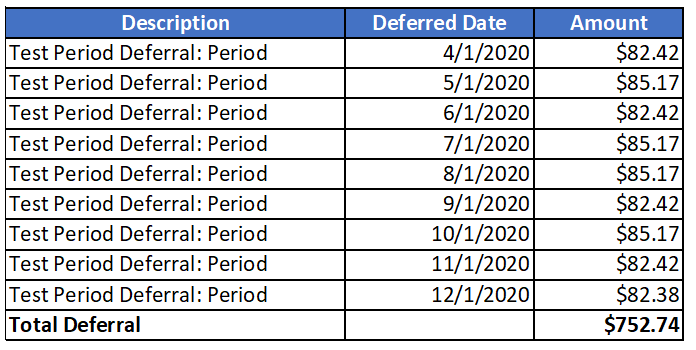
Example: A membership is renewed on 3/12/2020 for $1,000.00. The starting date of the entitlement is 1/1/2020 and the ending date is 12/31/2020. Since the batch control date of 3/12/2020 is part way through the period of entitlement, some of the income will be earned and some deferred. the AMS calculates the daily rate of $2.7473. The months of January, February and all of March total 90 days. The earned amount is 90 * $2.7473 or $247.26. The deferred amount is the balance or $752.74. The AMS actually calculates the deferred amount by calculating the number of days in each future month, multiplying that times $2.7473 and adding any fractional pennies to the last month. A distinct row is added to the deferred income database table for each month. This enables the AMS to report to you how much income may be moved from deferred to earned on a monthly basis.
Annual Deferral - Conservative
Annual deferrals are like period deferrals without as much recordkeeping. Annual deferrals use a starting and ending date to calculate the duration of the period and the inclusive number of days within the period. This is commonly used for deferrals of entitlements spread over a period of several years. Examples are donations, grants, and any period type entitlement where lump-sum distributions are preferred over monthly distributions.
Example: A donation is made on 3/12/2020 for $1,000.00. The donation is for the building fund and is to cover the period from 1/1/2020 to 10/30/2022 when the building will be finished. Since the batch control date of 3/12/2020 is part way through the first year of entitlement, some of the income will be earned and some deferred. The AMS calculates the daily rate of $0.9681. The months of January, February and all of March total 90 days. The earned amount is 90 * $0.9681 or $87.13. The deferred amount is the balance or $912.87. The AMS actually calculates the deferred amount by calculating the number of days in each future month, multiplying that times $0.9681 and adding any fractional pennies to the last month. A distinct row is added to the deferred income database table for each deferral year. For 2020, $265.21 is deferred. For 2021, $353.34 is deferred. For 2022, $293.32 is deferred. This enables the AMS to report to you how much income may be moved from deferred to earned on an annual basis.
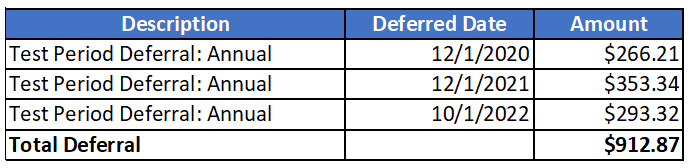
The Conservative approach uses the latest date in the period to recognize the income. That is, you do not get the money until all of it has been earned for the period.
Annual Deferral - Early
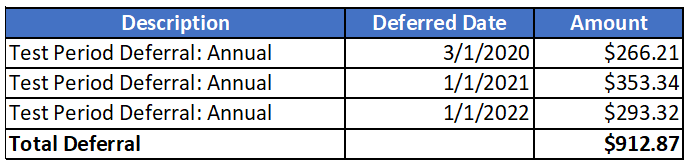
Early does the same calculations as the conservative method above. The only difference is instead of waiting to the end of a period to get the money, you get the money (earned) at the beginning of the period.
Event Deferral
As you plan your meetings and events, you decide to defer any early and advance registration income until the starting day of the event. After that date all registration income collected will be considered earned income.
Example: An event is set up for 10/16/2020. Registration opens in March, 2010, and $1,000.00 is collected on the 12th. Since the event is in the future, the AMS will defer the entire amount to the starting date of the event, 10/16/2020. the AMS will continue this practice through 10/15/2020. Starting on 10/16/2020 any funds collected will be posted to the earned income account and the accounting office will journal the pre-event balance to earned income.

Lump Sum Deferral
Use the Lump Sum deferral method if you decide to defer any early income until the starting day of the entitlement. After that date all income collected will be considered earned income.
Example: A membership is set up for 7/1/2020 through 6/30/2021. Renewal season opens in March, 2020, and $1,000.00 is collected on the 12th. Since the entitlement is in the future, the AMS will defer the entire amount to the starting date of the entitlement, 7/1/2020. the AMS will continue this practice through 6/30/2020. Starting on 7/1/2020 any funds collected will be posted to the earned income account and the accounting office will journal the pre-entitlement balance to earned income.
Until Deferral
As you plan your finances, you decide to defer any income until a specific day. After that date all income collected will be considered earned income.
Example: A membership renewal period is established from 7/1/2020 to 6/30/2021. Renewal season opens in January, 2020, and $1,000.00 is collected on March 12th. Since the “Until” date of 7/1/2020 is in the future, the AMS will defer the entire amount. the AMS will continue this practice through 6/30/2020. Starting on 7/1/2020 any funds collected will be posted to the earned income account and the accounting office will journal the prior deferred balance to earned income.
All Deferral
With All Deferrals there are no calculations. Every collection is deferred, all of the time, until 1/1/2090. Or at least until you change the rule or journalize the funds to earned income.
None Deferral
None is the reverse of All. Every collection is earned, all of the time, forever. If the Deferred GL Account and method of deferral in the Hotkey is left blank, it is treated as NONE.
For reporting on deferrals, please refer to the Deferred Income section of the Financial Reports article.